X rewards two things above all else: consistency and a first line that stops the scroll. The problem is that writing tweets and threads by hand, every day, is the fastest way to burn out and go quiet. The fix is to generate X posts and threads programmatically and keep a human on the final call.
This guide is the technical walk-through: authentication, request and response shapes, how to handle threads, and the engagement patterns the X algorithm actually rewards. If you have read our LinkedIn developer guide, this is the X counterpart, and X plays by very different rules.
Why X is different from every other platform
Generic AI output fails on X faster than anywhere else, because the format is unforgiving. A purpose-built content API has to account for these:
- 280 characters, and the first line carries everything. Most clients preview only the opening ~50 characters. If line one does not earn the tap, nothing else you wrote matters.
- Line breaks are a feature, not decoration. White space between ideas roughly doubles how scannable a post feels in the timeline.
- Threads and single posts serve different jobs. Single posts win for moments and hot takes. Threads win for evergreen, save-worthy breakdowns.
- Bookmarks are the strongest signal. On X, a save is a stronger intent signal than a like, and it correlates with distribution. Write posts worth coming back to.
- Hashtags are mostly noise. Zero to two, only when the tag is a real category like #buildinpublic. More than that reads as brand-y and suppresses reach.
Authentication
Every request uses a Bearer token. Generate an API key from the dashboard after signing up:
Authorization: Bearer sp_your_api_key_hereGenerate a single X post
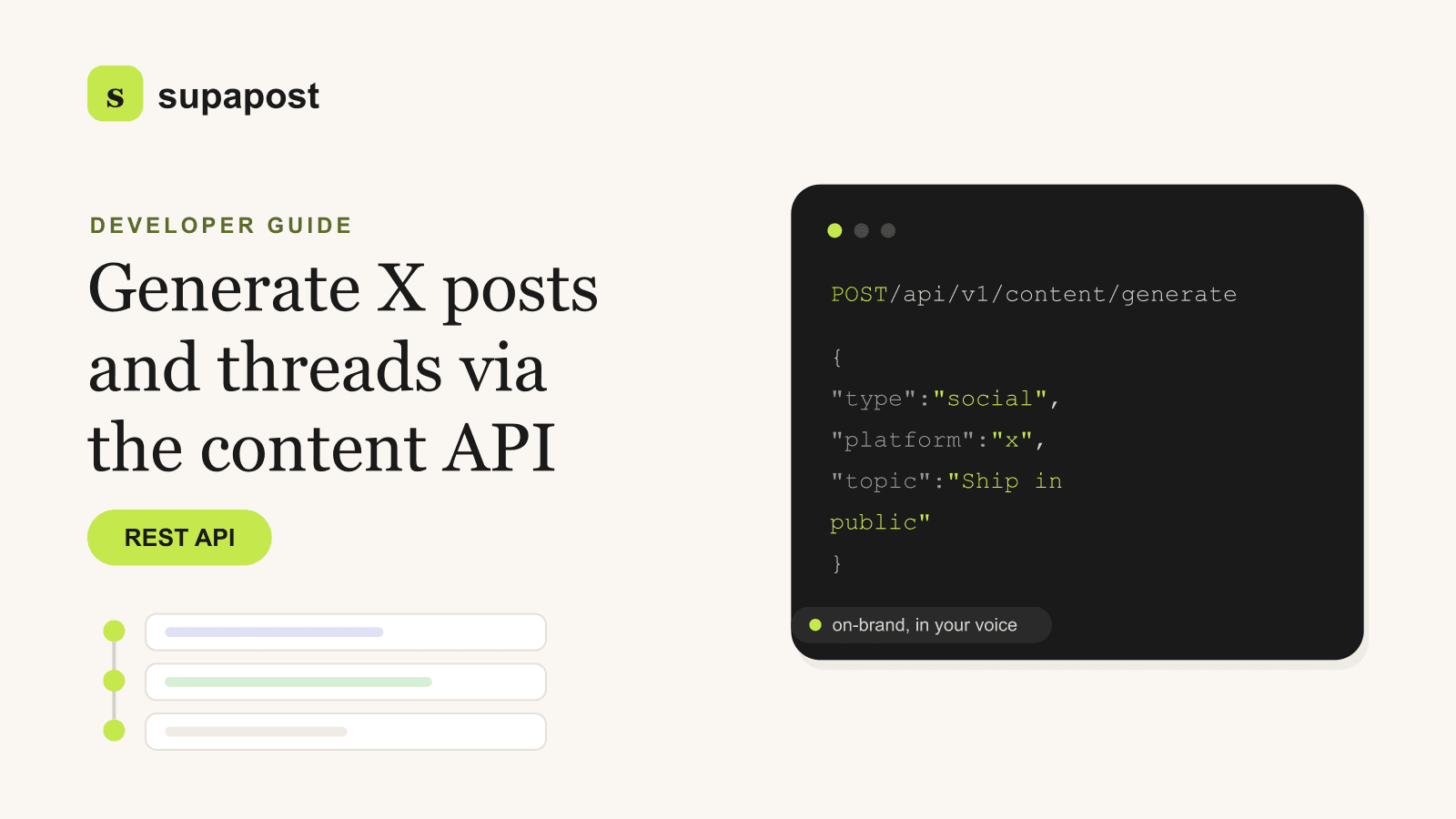
Use the unified content endpoint with platform: "x":
curl -X POST https://supapost.ai/api/v1/content/generate \
  -H "Authorization: Bearer sp_your_key" \
  -H "Content-Type: application/json" \
  -d '{
    "type": "social",
    "platform": "x",
    "topic": "Why most startups over-invest in product and under-invest in distribution"
  }'
Response format
{
  "type": "social",
  "platform": "x",
  "content": "Most startups die with a great product nobody heard about.\n\nDistribution isn't a phase you get to later.\n\nIt's the whole game.",
  "variations": [
    "You don't have a product problem. You have a distribution problem.",
    "Great product, zero distribution = a diary nobody reads."
  ],
  "hashtags": []
}
The primary content is formatted for X: short lines, deliberate breaks, under the character limit. You also get variations to test and a hashtag array that is usually empty on purpose, because restraint outperforms on X.
The first line is the whole game
The single highest-leverage edit you can make to any generated X post is the hook. Two opening patterns consistently outperform, both drawn from studying high-engagement posts:
- Two-line contradiction. State a comfortable belief, then snap it on the next line. "Talking about your idea feels like progress." / "It's not." Readers tag themselves and reply.
- Parenthetical amplifier. A blunt claim, then a parenthetical that raises the stakes before the body starts. "You're addicted to urgency." / "(And it's costing you everything)".
Ask the API for variations, then pick the hook that lands hardest for your audience. The generation gets you 90% of the way; your judgment on the opening line is the last 10% that decides reach.
Single posts versus threads
Match the format to the intent. For a moment, a reaction, or a one-line insight, a single post is stronger and easier to consume. For an evergreen breakdown that people will want to save, build a thread: an opening post that promises a clear payoff, then one idea per post, each able to stand alone.
The programmatic pattern for a thread is to generate the hook post first, then generate each beat from the same topic so the voice stays consistent across the thread:
{ "type": "social", "platform": "x", "topic": "Thread hook: 5 distribution channels founders ignore" }Then generate each follow-on post per channel from the same workspace. Because brand voice lives on the workspace, every post in the thread sounds like one coherent author rather than five disconnected tweets.
Brand context is what stops it sounding generic
Output quality depends almost entirely on your workspace settings. Before generating, make sure your workspace has a brand voice, industry, target audience, and content pillars configured. The fastest way is to enter your website URL during onboarding and let brand detection fill these in automatically, then refine.
With that context in place, the API is not writing generic tweets. It is writing posts in your voice, about your topics, for your audience. That is the difference between content that gets scrolled past and content that gets saved.
Replies are the other half of growth on X
Posting is only half the engine. Replying to comments and mentions in a way that sounds human is how accounts actually grow. The same endpoint generates contextual replies:
curl -X POST https://supapost.ai/api/v1/content/generate \
  -H "Authorization: Bearer sp_your_key" \
  -H "Content-Type: application/json" \
  -d '{
    "type": "reply",
    "platform": "x",
    "originalPost": "Distribution is underrated but easier said than done. Where do you even start?",
    "tone": "conversational"
  }'
You get reply variations tuned to your brand voice and aware of what the person actually said, not the "Great point!" filler that kills engagement. There is a full breakdown in our guide on smart replies that do not sound like a bot.
Batch a week in one call
To plan ahead, the strategy endpoint turns one topic into a set of platform-native posts, so you can generate an X batch without writing each one:
curl -X POST https://supapost.ai/api/v1/strategy/generate \
  -H "Authorization: Bearer sp_your_key" \
  -H "Content-Type: application/json" \
  -d '{
    "topic": "Lessons from our first 1,000 users",
    "platforms": ["x"]
  }'
You can also feed an existing article into the repurpose endpoint to spin a blog post into a week of tweets. That pattern is covered in turning one blog post into ten social posts.
The engagement patterns that actually move reach
Whether you post generated content or hand-write it, the same rules apply on X:
- Earn the first line. The preview is roughly 50 characters. Front-load the tension or the payoff.
- Break up the lines. Empty lines between ideas make a post scannable in a fast-moving feed.
- Write for the bookmark. Save-worthy beats like-worthy. Frameworks, specific numbers, and clear lists get saved and redistributed.
- Keep hashtags to zero or one. Only use a tag if it is a genuine community category. More looks promotional.
- Reply to your own post within 30 minutes. An early self-reply with a related point boosts the algorithmic signal on the original.
- Test the variations. Generate three, ship the strongest hook, and feed what wins back into your content pillars.
Putting it together
The developer workflow that scales is simple: generate posts and threads via the API, generate replies as comments come in, review everything in a queue, and approve the best. The AI handles production. You handle the hook and the final call.
Start with one call. Point platform at x, feed it a real topic, and compare the output to what you would have written by hand. Then wire it into a schedule or an agentic workflow and let your X presence run without the blank-editor tax. The full API reference has every parameter, and the free tier gives you 50 requests a day to build against.